

|
Daniel BrownDaniel Brown is an award-winning researcher, social scientist, and founder of AB Labs. He holds a doctorate in Management from Harvard University and has conducted over 100 randomized controlled trials in social psychology.
|
Overview
We all have those friends who sacrifice sleep to get more work done. Maybe you’re one of them. To some, getting less shut-eye to get more done is a noble sacrifice. To others, it sets an undesirable standard, particularly amongst peers and colleagues. But it’s an open question how others view the sleep sacrificer.
In a previous experiment, we found that a hypothetical co-worker who stays to work later than other employees was liked less by peers. Does that hold true for a friend who isn’t even competing with you at the same company?
The Experiment
We conducted an experiment with 400 people on Amazon Mechanical Turk in which participants were told about a friend who either gets enough sleep or sacrifices sleep for work.
Participants were instructed as follows:
We all have those friends who sacrifice sleep to get more work done. Maybe you’re one of them. To some, getting less shut-eye to get more done is a noble sacrifice. To others, it sets an undesirable standard, particularly amongst peers and colleagues. But it’s an open question how others view the sleep sacrificer.
In a previous experiment, we found that a hypothetical co-worker who stays to work later than other employees was liked less by peers. Does that hold true for a friend who isn’t even competing with you at the same company?
The Experiment
We conducted an experiment with 400 people on Amazon Mechanical Turk in which participants were told about a friend who either gets enough sleep or sacrifices sleep for work.
Participants were instructed as follows:
Imagine you’re talking with a friend about daylight savings time, which leads to talking about sleep in general. Your friend mentions that they [usually get about 7 hours of sleep per night / work so much that they usually only get about 4 hours of sleep per night].
At this moment, how much do you like this person? (1 = Not at all, 7 = Extremely)
At this moment, how much do you like this person? (1 = Not at all, 7 = Extremely)
The phrase in brackets was randomly assigned to participants, so they only saw one of these two phrases. The likability question was asked on a 1-7 scale.
Results
We found a significant difference in likability between our 7-hour sleeper (avg. = 5.19) and 4-hour sleeper (avg. = 4.70), such that our work-more-sleep-less friend was liked quite a bit less (p < 0.001). This difference was about half of a point on our 1-7 scale, or approximately a 10% reduction.
Results
We found a significant difference in likability between our 7-hour sleeper (avg. = 5.19) and 4-hour sleeper (avg. = 4.70), such that our work-more-sleep-less friend was liked quite a bit less (p < 0.001). This difference was about half of a point on our 1-7 scale, or approximately a 10% reduction.
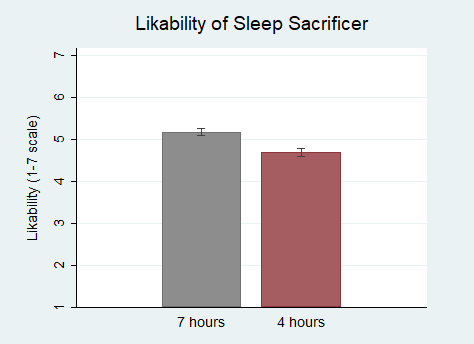
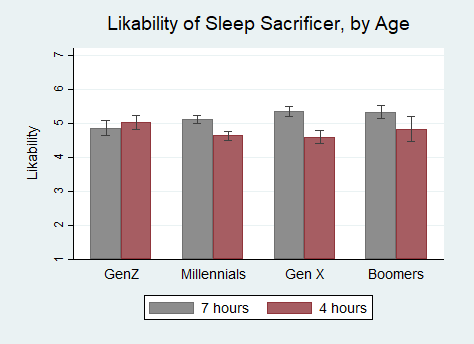
We also ran two exploratory tests to see if political beliefs or age influenced the results. We found no such effect for political beliefs (p = 0.561). We did, however, find a marginally significant effect of age (coeff. p = 0.052, F-test p < 0.001). Each additional year of age was associated with a -0.019 lower like rating toward our 4-hour sleeper. For example, a 20-year-old would like our 4-hour sleeper only 0.14 points less, but a 60-year-old would like our 4-hour sleeper 0.90 points less.
As you can see from the graph below, this age effect was particularly pronounced for Millennials and Gen X—the two generations in the workforce.
Conclusion
If you tend to sacrifice sleep for work, you may not want to complain or brag about it to your friends or colleagues. You may even want to consider getting more sleep, if you can.
Popular Experiments

COVID MasksDoes wearing a COVID mask affect how others think of you?
|

Video GamesAre video games more enjoyable than board games?
Does age or gender matter? |

Zero-Sum PoliticsDo Democrats or Republicans view society as win-lose?
|