
Overview
Artificial intelligence (AI) is a field of growing interest. It’s also a field of growing ability. Whereas AI algorithms were once limited to mundane functions like automating simple tasks, AI is now being used in creative domains like art (Du Sautoy, 2019). The subject of whether AI can truly be creative is a fascinating topic.
But creativity is in the eye of the beholder. What we consider to be “art” may be socially limited to human creative endeavors. We're seeing this with ChatGPT and people's reactions to the creative works it produces. While these works may objectively pass as art, the public's subjective perceptions of them may differ.
This raises the question—do we think of works created by AI as art?
The Experiment
We had 400 people on Amazon Mechanical Turk view a painting that was attributed to either a human author or an AI algorithm (randomly assigned), then asked those participants whether they consider the painting to be “art” and how much they like it.
Participants were told, “The painting below was created by [Alfred Iodice / an AI algorithm].” Participants were then shown the painting below, which was in fact created by an AI algorithm.
Artificial intelligence (AI) is a field of growing interest. It’s also a field of growing ability. Whereas AI algorithms were once limited to mundane functions like automating simple tasks, AI is now being used in creative domains like art (Du Sautoy, 2019). The subject of whether AI can truly be creative is a fascinating topic.
But creativity is in the eye of the beholder. What we consider to be “art” may be socially limited to human creative endeavors. We're seeing this with ChatGPT and people's reactions to the creative works it produces. While these works may objectively pass as art, the public's subjective perceptions of them may differ.
This raises the question—do we think of works created by AI as art?
The Experiment
We had 400 people on Amazon Mechanical Turk view a painting that was attributed to either a human author or an AI algorithm (randomly assigned), then asked those participants whether they consider the painting to be “art” and how much they like it.
Participants were told, “The painting below was created by [Alfred Iodice / an AI algorithm].” Participants were then shown the painting below, which was in fact created by an AI algorithm.
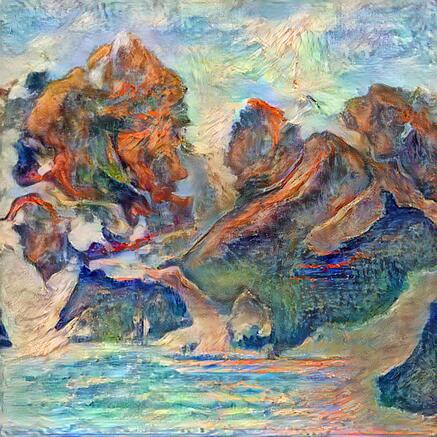
AI-generated painting, courtesy of Wikimedia Commons
Participants were then asked two questions, “To what extent do you think this painting is art? (1 = Not at all, 7 = Definitely art)” and “How much do you like this painting? (1 = Not at all, 7 = Very much),” both using a 1-7 scale.
Results
Our analysis found that the painting was significantly less likely to be considered art when it was attributed to an AI algorithm (avg. = 5.26) rather than a human (avg. = 5.91), (p < 0.001). Participants also liked the art less when it was attributed to AI (avg. = 4.76) than a human (avg. = 5.10), (p = 0.023).
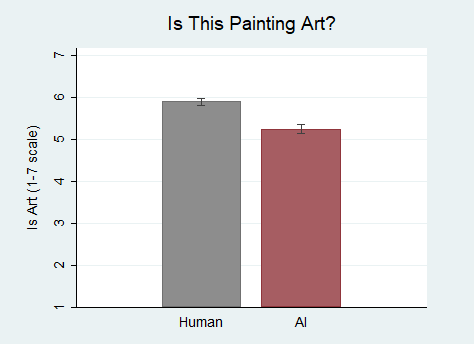
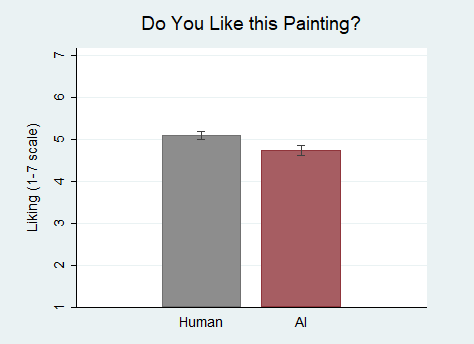
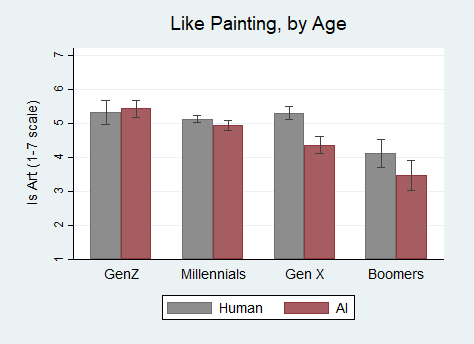
Notably, the results differed based on age. We found younger people were more accepting of the AI-attributed painting as art than their older counterparts. For every additional year of age, our participants’ “is art” ratings were 0.03 points lower (1-7 scale) for the AI-attributed painting than the human attributed painting (p = 0.027). For example, we’d expect a 20-year-old’s “is art” rating to only differ by about 0.12 points, whereas a 60-year-old’s rating would differ by about 1.33 points.
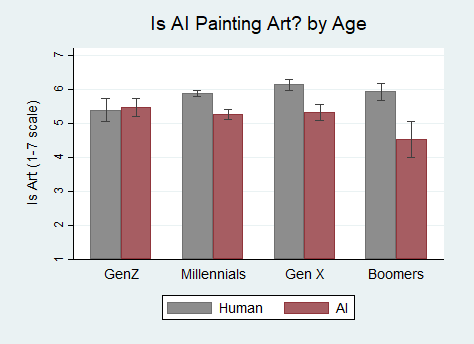
The age difference was only marginally significant for the painting’s likability (p = 0.088), but there was still an additional 0.024-point difference for each additional year of age, such that we’d expect 20-year-old’s and 60-year-old’s painting likability difference to be +0.09 and -0.89, respectively.
Conclusion
In the world of art perceptions, it looks like it’s rage against the machine. Irrespective of the actual art in question, people still view AI-generated art as inferior to art created by humans.
But it may not always be this way. Younger generations seem to be more accepting of AI art. In time, perhaps we all will become more accustomed to the idea of creative artificial intelligence.
Methods Note
We used an independent samples t-test to test for significant differences in perceptions between the AI and Human art conditions. For significant differences, the difference between the two groups' averages would be large and its corresponding “p-value” would be small. If the p-value is less than 0.05, we consider the difference statistically significant, meaning we'd likely find a similar effect if we ran the study again with this population. To test interaction effects, i.e., whether the results differ by age, we used OLS regression analyses with interaction terms.
References
Du Sautoy, M. (2019). The Creativity Code: Art and Innovation in the Age of AI. Harvard University Press.
Popular Experiments
COVID MasksDoes wearing a COVID mask affect how others think of you?
|
Video GamesAre video games more enjoyable than board games?
Does age or gender matter? |

Zero-Sum PoliticsDo Democrats or Republicans view society as win-lose?
|