AB Lab
  • Home
  • Research
    • Age
    • Art
    • Business
    • Climate Change
    • Communication
    • Fashion & Style
    • Food & Beverage
    • Fun & Games
    • Gender
    • Health
    • Research on Research
    • Politics
    • Relationships
    • Social Justice
    • Technology
    • Work
    • Other
  • Our Approach
    • Why Experiments
    • Experiments How-To
  • Authors

Company vs. University Research

Is corporate research as believable as research from a university?

​Overview

Research is typically thought to be the domain of universities. Indeed, colleges and universities produce the lion’s share of academic research. But for-profit companies also produce research, albeit more focused on practical implications.
 
Both domains of research have come under fire in recent years. For-profit corporations have faced accusations of conflicts of interest, such as studies on the health effects of sugar that were run by food and beverage companies (Kearns, et. al., 2016). Academics have faced criticism from over half of their studies in “top-tier” publications failing to replicate (Science, 2015), possibly due to their own conflicts of interest, such as publications being tied to tenure and high-status schools and positions.
 
So which is viewed as more credible, research from universities or corporations? Let’s put it to the test.
 
The Experiment
 
We conducted an experiment with 400 people on Amazon Mechanical Turk in which participants were told about a research finding, but randomly assigned to whether the source was a university or a corporation, specifically the University of Minnesota or 3M Company. Participants read the text below:

The following claim may or may not be true:
 
A research study from [the University of Minnesota / 3M Company] suggests that mindfulness meditation can reduce work stress.


Participants were then asked, "How strongly do you believe this research finding is true?" and responded by answering on a 1-7 scale (1 = Not at all, 7 = Very much).
 
Results
 
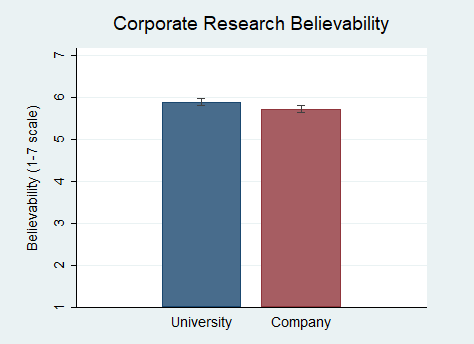
We found no significant difference in believability (1-7 scale) between the university research study (avg. = 5.90) and the corporate research study (avg. = 5.73) (p = 0.159). Interestingly, both research studies were rated highly believable, perhaps owing to the spotlight recently shone on mindfulness meditation research.
​​

Bar graph - COVID mask enhances likability, trust, talking

​One might expect that political beliefs could influence the believability of university vs. corporate research, perhaps with more conservative-leaning (i.e., pro-business) participants believing the company research more. But we found no such effect (p = 0.193).

Conclusion

It seems that whether a research study is published by a university or a company, the believability of that research might be similar in the eyes of readers. Now if we could just fix those pesky conflicts of interest.

 
References
 
Kearns CE, Schmidt LA, Glantz SA. (2016). Sugar Industry and Coronary Heart Disease Research: A Historical Analysis of Internal Industry Documents. JAMA Internal Medicine. 176(11):1680–1685.
 
Open Science Collaboration. (2015). Estimating the reproducibility of psychological science. Science, 349(6251).

Methods Note:
 

We used ordinary least squares (OLS) regression analysis to test for significant differences in believability between the company and university research conditions, For significant differences, the coefficient would be large and its corresponding “p-value” would be small. If the p-value is less than 0.05, we consider the difference statistically significant.

Popular Experiments

Exclamation Marks

COVID Masks

Does wearing a COVID mask affect how others think of you?
Video games arcade retro

Video Games

Are video games more enjoyable than board games?
​Does age or gender matter?
Political research

Zero-Sum Politics

Do Democrats or Republicans view society as win-lose?
Home
Topics
Methods
Support
Privacy
Contact
© 2023 AB Labs, Inc. All rights reserved.
  • Home
  • Research
    • Age
    • Art
    • Business
    • Climate Change
    • Communication
    • Fashion & Style
    • Food & Beverage
    • Fun & Games
    • Gender
    • Health
    • Research on Research
    • Politics
    • Relationships
    • Social Justice
    • Technology
    • Work
    • Other
  • Our Approach
    • Why Experiments
    • Experiments How-To
  • Authors