AB Lab
  • Home
  • Research
    • Age
    • Art
    • Business
    • Climate Change
    • Communication
    • Fashion & Style
    • Food & Beverage
    • Fun & Games
    • Gender
    • Health
    • Research on Research
    • Politics
    • Relationships
    • Social Justice
    • Technology
    • Work
    • Other
  • Our Approach
    • Why Experiments
    • Experiments How-To
  • Authors

Cookies: Manage or Reject

Does a website's cookie options nudge us to just accept all cookies?

​Overview

Data privacy has become a concern of netizens around the world. Despite progressive regulations such as the EU’s General Data Protection Regulation (GDPR), big tech companies’ approaches to how they use your data remain fragmented.
 
An annoying example of this is the infamous “Accept Cookies” pop-up on websites. A cookie is a small file that websites (and the companies behind them) put on your device to save information about you and your web visits. Cookies can be useful for things like saving your log-in credentials or shopping cart items. But they can also be used to track what other websites you visit across the internet.
 
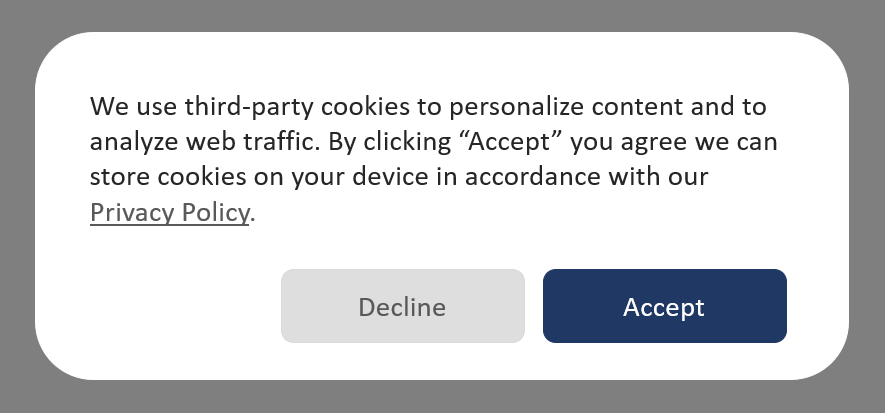
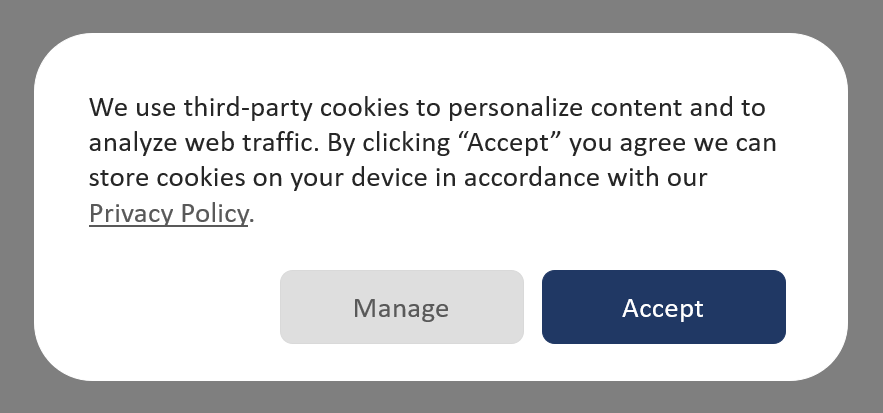
Some websites simply require you to Accept Cookies. Others offer you the option to Decline Cookies. But some offer you a sort of middle option, Manage Cookies.

In theory, a Manage Cookies option gives users more say on what types of cookies companies put on their devices. But in the one-click world of the web, the uncertainty of having to manage a cookies policy (and the several seconds it takes) may be enough to frustrate users into just accepting all cookies.
 
The Experiment
 
We conducted an experiment with 400 people on Amazon Mechanical Turk in which participants were instructed to “Imagine you click on a website to get information you need, but before you can view the information the following cookies banner pops up, requiring a response:” Participants were then shown one of the two photos below (randomly assigned):


Picture
Picture
​
Participants were then asked, "What would you click?” and responded by selecting one of the following four answer options [randomized conditions in brackets]:
  • Accept
  • [Decline / Manage]
  • Privacy Policy
  • Close the browser
 
Results
 
To analyze the results, we compared each of the four answer options between its “Decline” and “Manage” cookies options, using chi-squared tests of independence. We were particularly interested in what percentage of participants selected the Accept or Decline/Manage options.
 
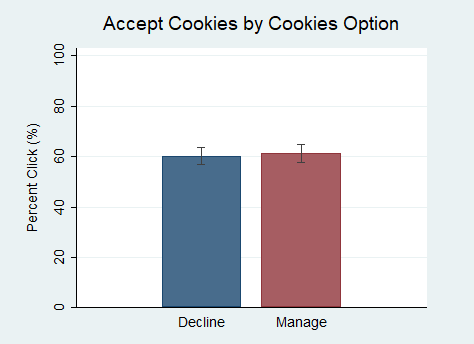
Starting with Accept, we found no significant difference between participants given a “Decline” option (60.2%) versus participants given a “Manage” option (61.3%), i.e., both groups were about equally likely to select “Accept” Cookies (p = 0.821). There was also no difference for Privacy Policy (8.0% vs. 7.5%, p = 0.875). 
Bar graph - AI Algorithms vs. Managers
Here’s where it gets interesting.
 
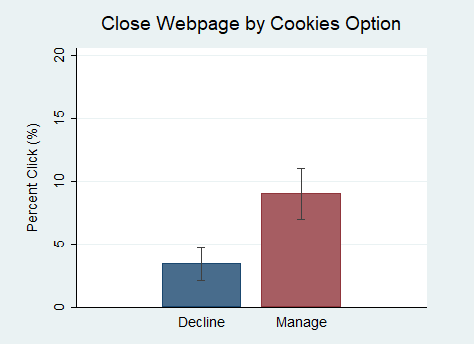
We found a small but insignificant difference in Decline/Manage selection between users given the Decline option (28.4%) vs. the Manage option (22.1%) (p = 0.150). But then we also found a small statistically significant difference in rates of Closing the webpage, in the opposite direction, between users given the Decline option (3.5%) vs. the Manage option (9.0%) (p = 0.022).
 
Users presented with “Manage” instead of “Decline” didn’t move to Accept—they closed the browser instead.

Bar graph - AI Algorithms vs. Managers, by Political Party (Democrats vs. Republicans)
Admittedly, this result was unexpected, and should probably be replicated using another experiment. A statistical power analysis revealed a 62.3% likelihood of finding the Close Browser effect (assuming it exists) given our sample size of 400 and 95% confidence. But the theory does seem reasonable. Anecdotally, asking a few others outside of this study confirmed that people do, in fact, close the browser when forced to choose manage or accept cookies.
 
Conclusion
 
To any companies trying to nudge web viewers into accepting cookies by making it harder to decline them, your strategy may have backfired. Instead of accepting or managing those cookies, website visitors are simply leaving, and taking their valuable traffic along with them. So if you own a website that uses a cookies banner or pop-up, it may benefit both you and your visitors to simply let them decline cookies.


Methods Note
 
We used chi-squared tests of independence to test for significant differences in participants' outcome responses (e.g., Accept Cookies) between our two conditions (Reject vs. Manage buttons). For significant differences, the difference between the two groups' percentages would be large and its corresponding “p-value” would be small. If the p-value is less than 0.05, we consider the difference statistically significant, meaning we'd likely find a similar effect if we ran the study again with this population.

Popular Experiments

Exclamation Marks

COVID Masks

Does wearing a COVID mask affect how others think of you?
Video games arcade retro

Video Games

Are video games more enjoyable than board games?
​Does age or gender matter?
Political research

Zero-Sum Politics

Do Democrats or Republicans view society as win-lose?
Home
Topics
Methods
Support
Privacy
Contact
© 2023 AB Labs, Inc. All rights reserved.
  • Home
  • Research
    • Age
    • Art
    • Business
    • Climate Change
    • Communication
    • Fashion & Style
    • Food & Beverage
    • Fun & Games
    • Gender
    • Health
    • Research on Research
    • Politics
    • Relationships
    • Social Justice
    • Technology
    • Work
    • Other
  • Our Approach
    • Why Experiments
    • Experiments How-To
  • Authors