
Overview
When it comes to dating, do opposites attract? Or do birds of a feather flock together?
At first blush, it's alluring to think we select a partner who makes up for our shortcomings. Concepts like our "other half" or someone who "completes" us have become common parlance. It may have been hardwired into early human brains, since diversification of skills likely aided survival and societal progress. A couple with both strength and smarts may have a leg up in raising a family, building a home, and getting work done.
But science also suggests that “birds of a feather flock to together.” In social circles, humans tend to prefer others more similar to themselves, a phenomenon we call "homophily." When it comes to dating, perhaps brainy people simply prefer other brainy people, and brawny people prefer other brawny people.
And then there's the question of pure attraction. Muscles may just be more inherently attractive than smarts, regardless of how similar or different the other person is. Then again, no matter how attractive a good physique may be, the thought of running 10Ks with your future partner may be anything but.
To get the bottom of this debate, we conducted a simple dating experiment involving brains vs. brawn. Do opposites attract? Or do birds of a feather flock together?
The Experiment
We had 400 people on Amazon Mechanical Turk read a short bio of a hypothetical person’s dating profile, randomizing their hobbies to be either brainy or brawny. Participants were then asked to rate how much they’d want to go on a date with the person.
Participants were instructed as follows:
When it comes to dating, do opposites attract? Or do birds of a feather flock together?
At first blush, it's alluring to think we select a partner who makes up for our shortcomings. Concepts like our "other half" or someone who "completes" us have become common parlance. It may have been hardwired into early human brains, since diversification of skills likely aided survival and societal progress. A couple with both strength and smarts may have a leg up in raising a family, building a home, and getting work done.
But science also suggests that “birds of a feather flock to together.” In social circles, humans tend to prefer others more similar to themselves, a phenomenon we call "homophily." When it comes to dating, perhaps brainy people simply prefer other brainy people, and brawny people prefer other brawny people.
And then there's the question of pure attraction. Muscles may just be more inherently attractive than smarts, regardless of how similar or different the other person is. Then again, no matter how attractive a good physique may be, the thought of running 10Ks with your future partner may be anything but.
To get the bottom of this debate, we conducted a simple dating experiment involving brains vs. brawn. Do opposites attract? Or do birds of a feather flock together?
The Experiment
We had 400 people on Amazon Mechanical Turk read a short bio of a hypothetical person’s dating profile, randomizing their hobbies to be either brainy or brawny. Participants were then asked to rate how much they’d want to go on a date with the person.
Participants were instructed as follows:
Imagine you’re looking for a relationship, so you decide to use an online dating app. You come across the dating profile below. This person is the gender you are interested in, and is fairly attractive.
- Name: Jamie
- Eye Color: Brown
- Hobbies: [Running, Athletics, Fitness / Reading, Writing, Learning]
Participants were then asked, “How much would you want to go on a date with this person? (1 = Not at all, 7 = Very much)” on a 1-7 scale.
To test the "opposites attract" vs. "birds of a feather" hypotheses, we asked participants at the end of the study “Which of the following hobbies do you regularly engage in (if any)?” Answer options included reading, writing, and fitness.
Results
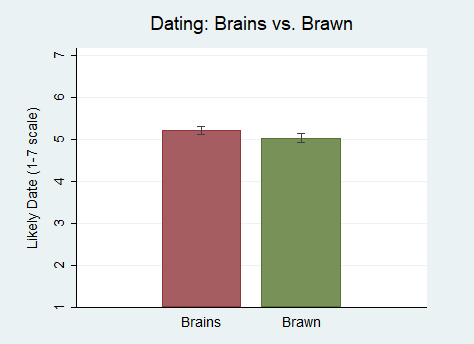
First, we tested the simple comparison of brains vs. brawn. In this case, it's a stalemate. Looking only at brains vs. brawn overall, we found no statistically significant difference in desire to date between our brawny bio (avg. = 5.04) and our brainy bio (avg. = 5.23), (p = 0.204).
To test the "opposites attract" vs. "birds of a feather" hypotheses, we asked participants at the end of the study “Which of the following hobbies do you regularly engage in (if any)?” Answer options included reading, writing, and fitness.
Results
First, we tested the simple comparison of brains vs. brawn. In this case, it's a stalemate. Looking only at brains vs. brawn overall, we found no statistically significant difference in desire to date between our brawny bio (avg. = 5.04) and our brainy bio (avg. = 5.23), (p = 0.204).
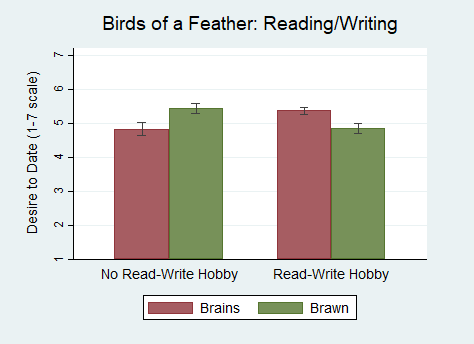
However, we did find support for the “birds of a feather” hypothesis. It appears that brainy people really prefer to date other brainy people, whereas brawny people have a slight preference for other brawny people. When comparing participants who selected “reading” or “writing” as a hobby versus participants who didn’t, we find that readers/writers desired to date our brainy bio person 0.52 points more (10.7%) than our brawny bio person; participants who did not select reading or writing as a hobby desired to date our brawny bio person 0.62 points more (12.7%) than our brainy bio person (p = 0.001).
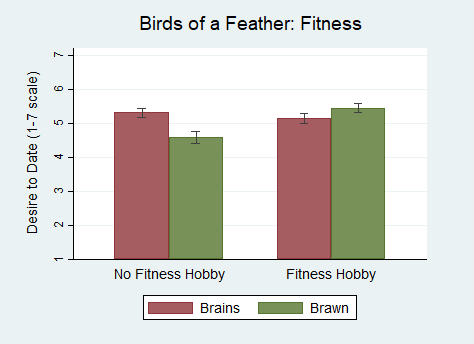
Similarly, when comparing participants who selected “fitness” as a hobby versus those who didn’t, we find that fitness hobbyists desired to date our brawny bio person 0.31 points more (6%) than our brainy bio person, whereas those who didn’t select fitness as a hobby desired to date our brainy bio person 0.74 points more (16%) than our brawny bio person (p < 0.001).
Conclusion
So, there you have it. Birds of a feather flock together, even in the world of dating. Despite the conventional wisdom that opposites attract, the results of our experiment show the opposite. And while there is no victor in the battle of brains vs. brawn directly, each side certainly seems to be rooting for their own team.
Methods Note:
We used independent samples t-tests to test for significant differences in dating perceptions between our two experimental conditions. For significant differences, the difference between the two groups' averages would be large and its corresponding “p-value” would be small. If the p-value is less than 0.05, we consider the difference statistically significant, meaning we'd likely find a similar effect if we ran the study again with this population. To test for interaction effects, we used OLS regression analyses with interaction terms.
Popular Experiments

COVID MasksDoes wearing a COVID mask affect how others think of you?
|

Video GamesAre video games more enjoyable than board games?
Does age or gender matter? |
Zero-Sum PoliticsDo Democrats or Republicans view society as win-lose?
|