
Overview
When the internet was in its infancy, only a few types of domains were common (e.g., .com, .org., .net). In recent years there seems to have been a proliferation of domains. In fact, a recent survey by Statista found that 52.3% of websites use .com, 4.4% .org, and 3.3% .net (Statista, 2021). Various country-specific domains comprise much of the rest.
One thing that hasn't changed, however, is the abundance of sketchy links to malicious websites. It made us wonder whether trust in a website is at all dependent on the website's domain. So of course, we tested it.
The Experiment
We conducted an experiment with 400 people on Amazon Mechanical Turk to test whether seeing a link to a website as URL.com vs. URL.net affects trust. Participants were told the following:
When the internet was in its infancy, only a few types of domains were common (e.g., .com, .org., .net). In recent years there seems to have been a proliferation of domains. In fact, a recent survey by Statista found that 52.3% of websites use .com, 4.4% .org, and 3.3% .net (Statista, 2021). Various country-specific domains comprise much of the rest.
One thing that hasn't changed, however, is the abundance of sketchy links to malicious websites. It made us wonder whether trust in a website is at all dependent on the website's domain. So of course, we tested it.
The Experiment
We conducted an experiment with 400 people on Amazon Mechanical Turk to test whether seeing a link to a website as URL.com vs. URL.net affects trust. Participants were told the following:
Suppose you are searching the internet for random facts and the following URL link appears in your search results:
https://www.everday-information.com[.net]
To what extent do you trust this URL?
(1 = Not at all, 7 = Extremely)
https://www.everday-information.com[.net]
To what extent do you trust this URL?
(1 = Not at all, 7 = Extremely)
Participants were randomly shown the link as either ending in .com or .net, then answered the survey question using a 1-7 scale.
Results
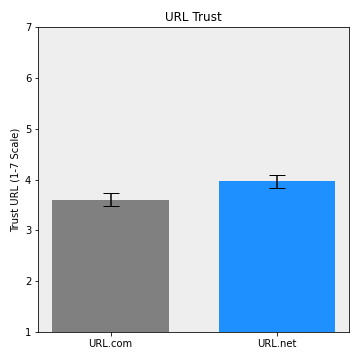
We found a small but significant difference of 0.36 on a 1-7 scale between the URL.com condition (avg. = 3.61) and the URL.net condition (avg. = 3.97), a difference of about 10% (p = 0.04). However, this effect was the opposite of what we'd hypothesized; it turns out .net websites were trusted more than .com websites.
Results
We found a small but significant difference of 0.36 on a 1-7 scale between the URL.com condition (avg. = 3.61) and the URL.net condition (avg. = 3.97), a difference of about 10% (p = 0.04). However, this effect was the opposite of what we'd hypothesized; it turns out .net websites were trusted more than .com websites.
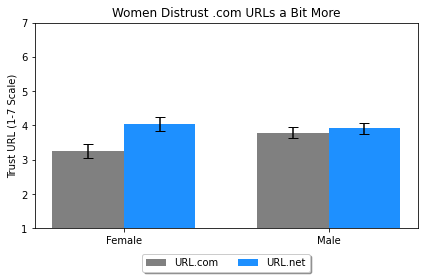
Interestingly, we also found that the results differ slightly by gender. We found a marginally significant "difference in differences" (0.66; p = 0.069), such that women trusted the .net URL significantly more than .com, but men showed no such difference. We can only speculate as to why. This URL-gender interaction could just be due to statistical chance. Nevertheless, it's an interesting finding that could merit a follow-up study.
Methods Note
We used ordinary least squares (OLS) regression analyses to test for significant differences in perceived trust between the URL.com and URL.net conditions. For significant differences, the difference between the two groups' averages would be large and its corresponding “p-value” would be small. If the p-value is less than 0.05, we consider the difference statistically significant, meaning we'd likely find a similar effect if we ran the study again with this population. To test whether differences for specific groups differ significantly from their counterparts (e.g., women vs. men) we used OLS regression analyses with interaction terms.
Citations
Statista. Most popular top-level domains worldwide as of April 2021.
https://www.statista.com/statistics/265677/number-of-internet-top-level-domains-worldwide/
We used ordinary least squares (OLS) regression analyses to test for significant differences in perceived trust between the URL.com and URL.net conditions. For significant differences, the difference between the two groups' averages would be large and its corresponding “p-value” would be small. If the p-value is less than 0.05, we consider the difference statistically significant, meaning we'd likely find a similar effect if we ran the study again with this population. To test whether differences for specific groups differ significantly from their counterparts (e.g., women vs. men) we used OLS regression analyses with interaction terms.
Citations
Statista. Most popular top-level domains worldwide as of April 2021.
https://www.statista.com/statistics/265677/number-of-internet-top-level-domains-worldwide/
Popular Experiments

COVID MasksDoes wearing a COVID mask affect how others think of you?
|

Video GamesAre video games more enjoyable than board games?
Does age or gender matter? |

Zero-Sum PoliticsDo Democrats or Republicans view society as win-lose?
|