
Overview
It’s the thought that counts. Or at least that’s what we say when it comes to giving gifts. But do we really think that way?
In the previous experiment, we found that gift bags do not increase excitement for a gift relative to plain brown paper bags. But what about the price of the gift itself? Might how expensive a gift is influence how much we like it? Perhaps it even influences how much we like the giver.
To find out, we continued our gift experiment with a grand reveal of the gift—and its price.
The Experiment
We recruited 400 people from Amazon Mechanical Turk to participate in a vignette study (i.e., a hypothetical scenario) about receiving a gift from a friend that either costs $5, $30, or $100, randomly assigned. We then asked them how much they like the gift and the giver.
Participants were instructed to read the following description after being informed they were given a hypothetical gift bag from a friend. “You open the gift bag and discover that your friend got you a [$5 (on sale) / $30 / $100] desk ornament called a Moon Lamp (pictured below).” To enhance realism, participants were shown the following image.
It’s the thought that counts. Or at least that’s what we say when it comes to giving gifts. But do we really think that way?
In the previous experiment, we found that gift bags do not increase excitement for a gift relative to plain brown paper bags. But what about the price of the gift itself? Might how expensive a gift is influence how much we like it? Perhaps it even influences how much we like the giver.
To find out, we continued our gift experiment with a grand reveal of the gift—and its price.
The Experiment
We recruited 400 people from Amazon Mechanical Turk to participate in a vignette study (i.e., a hypothetical scenario) about receiving a gift from a friend that either costs $5, $30, or $100, randomly assigned. We then asked them how much they like the gift and the giver.
Participants were instructed to read the following description after being informed they were given a hypothetical gift bag from a friend. “You open the gift bag and discover that your friend got you a [$5 (on sale) / $30 / $100] desk ornament called a Moon Lamp (pictured below).” To enhance realism, participants were shown the following image.

Participants were then asked, “How much do you like this [$5 / $30 / $100] desk ornament?” and “How much do you like this friend?” both using a 1-7 scale (1 = Not at all, 7 = Extremely).
Results
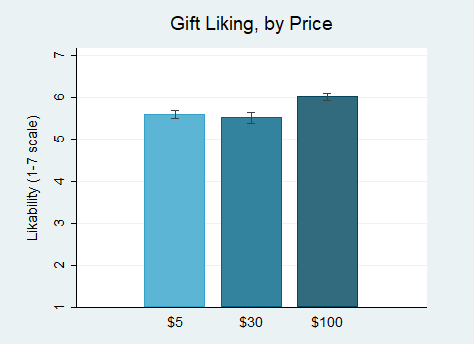
OLS regression analysis revealed a significant difference in how much participants liked the hypothetical gift (F = 6.32, p = 0.002). On average, participants liked the $100 gift (Avg. = 6.02) significantly more than the $30 gift (Avg. = 5.52) and the $5 gift (Avg. = 5.60). There was no significant different between the $5 and $30 gifts. There were also no interactions with age or gender.
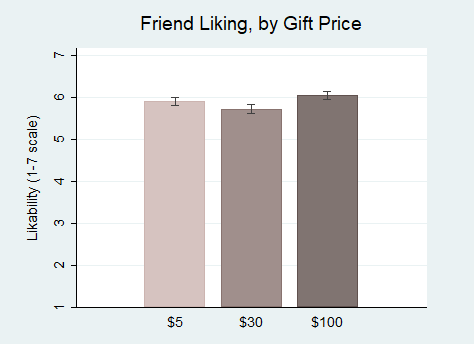
Next, we turn to the gift giver. Does a more expensive gift increase the giver’s likability? Our regression analysis revealed a small, possible yes (F = 2.70, p = 0.068). Compared to both the $5 gift (Avg. = 5.91) and the $30 gift (Avg. 5.73), the $100 gift (Avg. = 6.05) earned our giver marginally more likability. It was a small effect, however, only a fifth of a standard deviation difference. Again, there were no interaction with gender or age.
Conclusion
When it comes to gifts, the thought does counts. But apparently price is included in those thoughts. Although people didn’t care much whether a gift costs $5 or $30, they liked the gift a fair amount more when it cost $100. The $100 price tag seemed to earn the gift giver a bit more likability as well. Although that’s probably not great news for gift givers, it’s good to know if you’re really trying to wow the gift recipient.
Conclusion
When it comes to gifts, the thought does counts. But apparently price is included in those thoughts. Although people didn’t care much whether a gift costs $5 or $30, they liked the gift a fair amount more when it cost $100. The $100 price tag seemed to earn the gift giver a bit more likability as well. Although that’s probably not great news for gift givers, it’s good to know if you’re really trying to wow the gift recipient.
Methods Note
We used OLS regression analysis to test for significant differences in perceptions between our experimental conditions. For significant differences, the difference between the groups' averages would be large and their corresponding “p-values” would be small. If the p-value is less than 0.05, we consider the difference statistically significant, meaning we'd likely find a similar effect if we ran the study again with this population. To test for significant interactions between the main results and participant demographics, we used OLS regression analyses with interaction terms.
Methods Note
We used OLS regression analysis to test for significant differences in perceptions between our experimental conditions. For significant differences, the difference between the groups' averages would be large and their corresponding “p-values” would be small. If the p-value is less than 0.05, we consider the difference statistically significant, meaning we'd likely find a similar effect if we ran the study again with this population. To test for significant interactions between the main results and participant demographics, we used OLS regression analyses with interaction terms.
Popular Experiments

COVID MasksDoes wearing a COVID mask affect how others think of you?
|

Video GamesAre video games more enjoyable than board games?
Does age or gender matter? |

Zero-Sum PoliticsDo Democrats or Republicans view society as win-lose?
|