AB Lab
  • Home
  • Research
    • Age
    • Art
    • Business
    • Climate Change
    • Communication
    • Fashion & Style
    • Food & Beverage
    • Fun & Games
    • Gender
    • Health
    • Research on Research
    • Politics
    • Relationships
    • Social Justice
    • Technology
    • Work
    • Other
  • Our Approach
    • Why Experiments
    • Experiments How-To
  • Authors

Green Products & Likability

Does Buying Environmentally Friendly Products Make Others Like You More?

​Overview
 
Concerns about climate change and harm to the environment have prompted many people to purchase environmentally sustainable products. In addition to being good for the planet, we also wondered whether such "green purchases" make you more likable. And if so, does this likability boost come from people generally, or just those who espouse similar environmentally friendly beliefs (i.e., more politically liberal people)?
 
The Experiment

We conducted an experiment with 400 people on Amazon Mechanical Turk to test whether purchasing Brand Products vs. Green Products increases likability, and whether such an effect differs based on political beliefs. 

Participants were told "Imagine you're attending a house party hosted by a new acquaintance. You look around the room and notice several [environmentally friendly / name-brand] products, such as [energy-efficient light bulbs and eco-friendly dish soap / Philips light bulbs and Dawn dish soap]. Participants were then asked, "How much do you like this person?" (1 = Not at all, 7 = Extremely).
​Results
 
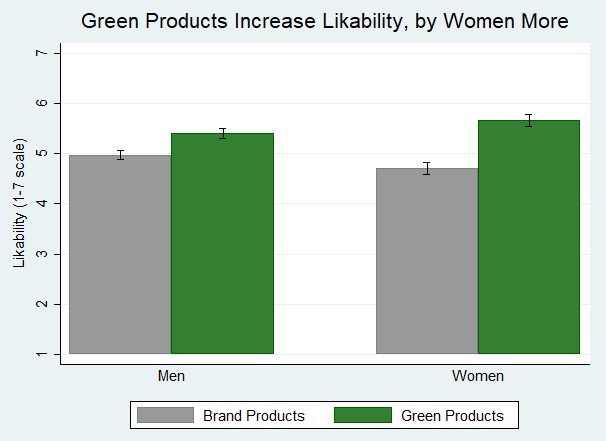
Overall, we found a very significant difference of 0.63 (on a 1-7 scale) between the Brand Products condition (avg. = 4.88) and the Green Products condition (avg. = 5.51), a difference of 12.8% (p < 0.001). An interaction test revealed that the difference was even more pronounced for female respondents (diff = 0.95) than male respondents (diff = 0.44), (p = 0.019).
Bar graph - COVID mask enhances likability, trust, talking
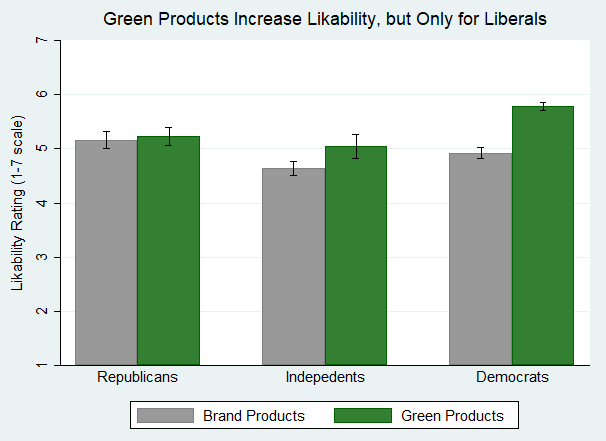
Finally, we tested whether the results differ between Republican, Independent, and Democrat respondents. We found a significant interaction (p < 0.001), such that the difference between the Brand Products and Green Products conditions for Democrat respondents (diff = 0.86) was significantly higher than the difference for Independents (diff = 0.41) and Republican respondents (diff = 0.07).
Picture
Conclusion

If you're hoping for a likability boost from buying products that are good for the environment, you should look to your liberal and female friends. Or you could just buy environmentally friendly products because, you know, it's good for the environment.

Methods Note:
 

To test for differences in likability between our name-brand products and green products buyer, we used ordinary least squares (OLS) regression analysis. From these analyses, a significant difference would have a large coefficient and a small corresponding “p-value” (when p is less than 0.05 we consider the difference statistically significant). To test differences between our two main conditions across genders and political parties, we used OLS regressions with interaction terms.

Popular Experiments

Exclamation Marks

COVID Masks

Does wearing a COVID mask affect how others think of you?
Video games arcade retro

Video Games

Are video games more enjoyable than board games?
​Does age or gender matter?
Political research

Zero-Sum Politics

Do Democrats or Republicans view society as win-lose?
Home
Topics
Methods
Support
Privacy
Contact
© 2023 AB Labs, Inc. All rights reserved.
  • Home
  • Research
    • Age
    • Art
    • Business
    • Climate Change
    • Communication
    • Fashion & Style
    • Food & Beverage
    • Fun & Games
    • Gender
    • Health
    • Research on Research
    • Politics
    • Relationships
    • Social Justice
    • Technology
    • Work
    • Other
  • Our Approach
    • Why Experiments
    • Experiments How-To
  • Authors