
Overview
Companies are increasingly demanding more skilled workers. Coincidentally, advancements in online technology have enabled skill-building on countless subjects around the world, from practically anywhere.
But do employers view an online degree as equally valuable as a traditional, in-person degree? There seem to be mixed views on the subject. So of course, we tested it ourselves.
The Experiment
We recruited 400 people from Amazon Mechanical Turk to read a hypothetical scenario about screening a job applicant who holds a bachelor’s degree from either a traditional or online university program (randomly assigned). We then asked them how competent the applicant seemed.
Participants were told the following:
Companies are increasingly demanding more skilled workers. Coincidentally, advancements in online technology have enabled skill-building on countless subjects around the world, from practically anywhere.
But do employers view an online degree as equally valuable as a traditional, in-person degree? There seem to be mixed views on the subject. So of course, we tested it ourselves.
The Experiment
We recruited 400 people from Amazon Mechanical Turk to read a hypothetical scenario about screening a job applicant who holds a bachelor’s degree from either a traditional or online university program (randomly assigned). We then asked them how competent the applicant seemed.
Participants were told the following:
Imagine you’re helping your boss sort through resumes of applicants to an administrative assistant job at your company. Below is some information about a candidate:
- Name: Alex
- Experience: 4 years at Best Buy
- Education: B.S. from Arizona State University [(online program)]
Participants were then asked “How competent does this person seem to you? (1 = Not at all, 7 = Extremely)” using a 1-7 scale.
Results
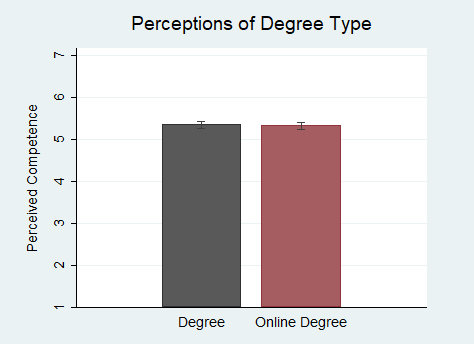
An independent samples t-test revealed no significant difference in perceived competence between our online degree holder (avg. = 5.33) and traditional degree holder (avg. = 5.36), (p = 0.808). The results weren’t affected by participants’ gender or age.
Results
An independent samples t-test revealed no significant difference in perceived competence between our online degree holder (avg. = 5.33) and traditional degree holder (avg. = 5.36), (p = 0.808). The results weren’t affected by participants’ gender or age.
One challenge to these results is that our sample consisted of a pool of online participants, as opposed to hiring managers. However, not all MTurk workers work primarily online for MTurk requesters. Many have jobs elsewhere (i.e., in physical spaces) with higher degrees of education and simply use MTurk to pass the time or make some side income. Our sample consisted of a mix of people from different educational backgrounds, with approximately 70% of our participants holding a bachelor’s degree or higher. Educational attainment did not significantly affect the results.
Conclusion
So, if you’re considering taking an online class (or whole degree) but are worried it might be less valued than a traditional (often more expensive) in-person degree, you may not need to worry so much. It seems that an online degree is roughly on-par with traditional degrees, at least in terms of the perceived competence of the degree holder.
We can’t say whether the actual quality differs though. That’s certainly an interesting avenue for future research.
Methods Note
We used an independent samples t-test to test for significant differences in perceptions between our two experimental conditions. For significant differences, the difference between the two groups' averages would be large and its corresponding “p-value” would be small. If the p-value is less than 0.05, we consider the difference statistically significant, meaning we'd likely find a similar effect if we ran the study again with this population. To test for significant interactions between the main results and participant demographics, we used OLS regression analyses with interaction terms.
Methods Note
We used an independent samples t-test to test for significant differences in perceptions between our two experimental conditions. For significant differences, the difference between the two groups' averages would be large and its corresponding “p-value” would be small. If the p-value is less than 0.05, we consider the difference statistically significant, meaning we'd likely find a similar effect if we ran the study again with this population. To test for significant interactions between the main results and participant demographics, we used OLS regression analyses with interaction terms.
Popular Experiments

COVID MasksDoes wearing a COVID mask affect how others think of you?
|

Video GamesAre video games more enjoyable than board games?
Does age or gender matter? |

Zero-Sum PoliticsDo Democrats or Republicans view society as win-lose?
|