
Overview
Research on the negative health effects of smoking has been the primary weapon in the arsenal of opponents against the tobacco industry. But despite the well-known health consequences of smoking, millions of people decide to light up each day. The habit is one of addiction for many established smokers. But for new smokers, the psychology of wanting to look cool may in part be fueling its uptake.
Does smoking actually make you look cool? Surveys have been done on the subject, but more rigorous randomized controlled trials have been lacking. Seiter and colleagues (2010) used such an experiment, however, with non-smoking college students. By randomizing identical photographs of models either smoking a cigarette or not, they found that non-smoking college students viewed smokers less favorably than nonsmokers in terms of attractiveness, likability, credibility, and other traits.
But would such findings generalize to the wider population? We ran a similar experiment to find out.
The Experiment
Using a similar experimental design as Seiter and colleagues, we tested whether smoking makes one look cool. But how do we define such a subjective concept? Wikipedia defines "cool" as an aesthetic of attitude, behavior, and style. So we asked our participants to rate our model along these three factors.
To conduct the experiment, we recruited 400 people from Amazon Mechanical Turk. Participants were shown one of two photos (randomly assigned) of a young man either smoking or not smoking while posing nonchalantly (photos obtained from Unsplash). These two photos were chosen for their similarity, to control for as many other possible confounding factors as possible.
Participants were told to “Imagine you’re walking down the street and see the person below,” before being shown one of the following photos.
Research on the negative health effects of smoking has been the primary weapon in the arsenal of opponents against the tobacco industry. But despite the well-known health consequences of smoking, millions of people decide to light up each day. The habit is one of addiction for many established smokers. But for new smokers, the psychology of wanting to look cool may in part be fueling its uptake.
Does smoking actually make you look cool? Surveys have been done on the subject, but more rigorous randomized controlled trials have been lacking. Seiter and colleagues (2010) used such an experiment, however, with non-smoking college students. By randomizing identical photographs of models either smoking a cigarette or not, they found that non-smoking college students viewed smokers less favorably than nonsmokers in terms of attractiveness, likability, credibility, and other traits.
But would such findings generalize to the wider population? We ran a similar experiment to find out.
The Experiment
Using a similar experimental design as Seiter and colleagues, we tested whether smoking makes one look cool. But how do we define such a subjective concept? Wikipedia defines "cool" as an aesthetic of attitude, behavior, and style. So we asked our participants to rate our model along these three factors.
To conduct the experiment, we recruited 400 people from Amazon Mechanical Turk. Participants were shown one of two photos (randomly assigned) of a young man either smoking or not smoking while posing nonchalantly (photos obtained from Unsplash). These two photos were chosen for their similarity, to control for as many other possible confounding factors as possible.
Participants were told to “Imagine you’re walking down the street and see the person below,” before being shown one of the following photos.

|

|
Participants were then asked “To what extent do you admire this person’s…” “Behavior,” “Attitude,” and “Style” (asked separately), then rated each word on a 1-7 scale (1 = Not at all, 7 = Extremely).
At the end of the activity, we surveyed people about their smoking habits to test whether the results differ between smokers and non-smokers. Participants were asked "Do you smoke cigarettes? (at least once per week)" and "Do you vape or smoke e-cigarettes? (at least once per week)" with both questions having answer options "Yes" and "No."
Results
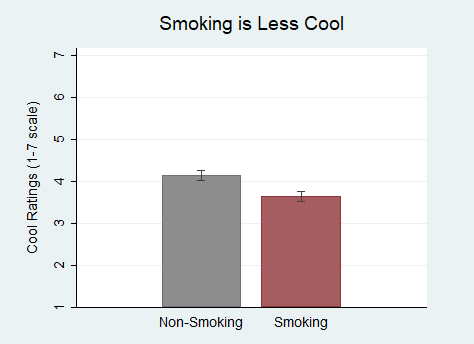
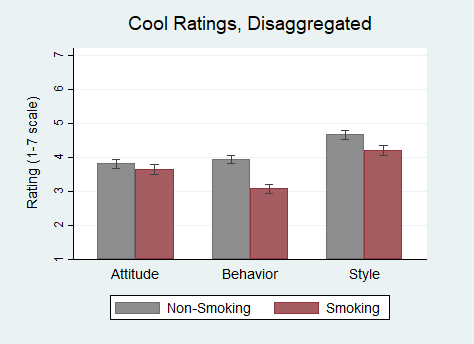
The results revealed that the model looked significantly less cool when smoking (avg. = 3.65) than when not smoking (avg. = 4.15), a difference of half a point on a 1-7 scale, or 12% (p = 0.005). Looking at the three dimensions of our “cool” variable, we found the key driver to be a sharp reduction in admiration for his behavior (difference = -0.87, p < 0.001) and to a lesser extent style (diff. = -0.45, p = 0.022), but not attitude (diff. = -0.17, p = 0.378).
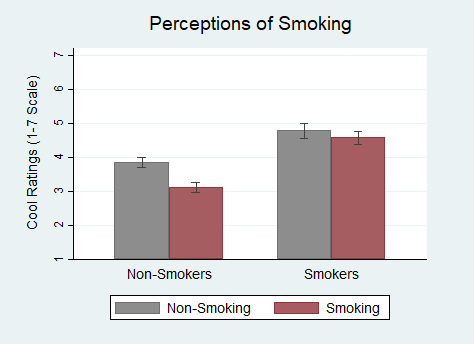
Finally, we wanted to test whether this negative smoking effect is driven only by non-smokers. After all, smokers may have picked up the habit at least in part because they thought it looked cool. So we tested whether the results differed between non-smokers and participants who smoke cigarettes or e-cigarettes (vaping).
Although we did not find a statistically significant interaction (p = 0.130), the results do suggest that smokers went easier on our model. Non-smokers rated him as 0.73 points less cool when smoking, whereas smokers only rated him 0.20 points lower when smoking. Importantly, we'd want to replicate this effect before putting too much confidence in it given the high p-value above 0.10.
Conclusion
In summary, if you’re considering taking up smoking for the cool factor, you might want to think again. Despite all of the imagery from Hollywood and marketing from the tobacco industry, everyday people do not view smoking as cool. And if that’s not enough reason to not smoke, there’s also the fact that it might kill you.
Methods Note
We used an independent samples t-test to test for significant differences in perceptions between our two experimental conditions. For significant differences, the difference between the two groups' averages would be large and its corresponding “p-value” would be small. If the p-value is less than 0.05, we consider the difference statistically significant, meaning we'd likely find a similar effect if we ran the study again with this population. To test for significant interactions between the main results and participant demographics, we used OLS regression analyses with interaction terms.
References
Seiter, John S, Weger, Harry, Merrill, Mandy L, Mark McKenna, R, and Sanders, Matthew L. 2010. “Nonsmokers' Perceptions of Cigarette Smokers' Credibility, Likeability, Attractiveness, Considerateness, Cleanliness, and Healthiness.” Communication Research Reports 27 (2): 143–58.
Methods Note
We used an independent samples t-test to test for significant differences in perceptions between our two experimental conditions. For significant differences, the difference between the two groups' averages would be large and its corresponding “p-value” would be small. If the p-value is less than 0.05, we consider the difference statistically significant, meaning we'd likely find a similar effect if we ran the study again with this population. To test for significant interactions between the main results and participant demographics, we used OLS regression analyses with interaction terms.
References
Seiter, John S, Weger, Harry, Merrill, Mandy L, Mark McKenna, R, and Sanders, Matthew L. 2010. “Nonsmokers' Perceptions of Cigarette Smokers' Credibility, Likeability, Attractiveness, Considerateness, Cleanliness, and Healthiness.” Communication Research Reports 27 (2): 143–58.

|
Daniel BrownDaniel Brown is an award-winning researcher, social scientist, and founder of AB Labs. He holds a doctorate in Management from Harvard University where he was awarded the Wyss Award for Excellence in Research in 2019. He has conducted hundreds of randomized controlled trials in social psychology.
|
Popular Experiments

COVID MasksDoes wearing a COVID mask affect how others think of you?
|

Video GamesAre video games more enjoyable than board games?
Does age or gender matter? |

Zero-Sum PoliticsDo Democrats or Republicans view society as win-lose?
|