
Overview
For better or worse, the working world is a fundamental part of most of our lives. Some take it more seriously than others. In our capitalist system where hard works is rewarded with better pay and promotions (so the theory goes, at least) it’s become common to see coworkers burning the candle from both ends, staying late to get more work done.
To some this might seem like a noble sacrifice, contributing to society at the detriment of the late worker. But to the coworkers also seeking those limited promotions and raises, it may be viewed as overly competitive, or setting a standard that they fear their bosses will want others to follow. It could also be viewed as an inability to get the work done in time, an opposite but equally negative view.
So, do coworkers hold these hard-workers in esteem or disdain? Let’s find out.
The Experiment
We conducted an experiment with 400 people on Amazon Mechanical Turk in which participants read a hypothetical scenario about a co-worker who either stays late or leaves on-time (randomly assigned). Participants then rated how much they like this co-worker.
Participants were instructed as follows: “Imagine you work in an office where almost everyone leaves around 5:00 PM. A co-worker who you just met usually chooses to [leave around that time, at 5:00 PM / work extra hours, leaving around 8:00 PM].”
Participants were then asked “How much do you like this co-worker? (1 = Not at all, 7 = Extremely)” using a 1-7 scale.
Results
If you’re a late worker, you may want to be a bit more discreet around your colleagues. The results revealed that our worker who stayed late until 8:00 PM was less liked (avg. = 4.72) than our worker who left on time at 5:00 PM (avg. = 5.03), a difference of about 6.2% (p = 0.013).
For better or worse, the working world is a fundamental part of most of our lives. Some take it more seriously than others. In our capitalist system where hard works is rewarded with better pay and promotions (so the theory goes, at least) it’s become common to see coworkers burning the candle from both ends, staying late to get more work done.
To some this might seem like a noble sacrifice, contributing to society at the detriment of the late worker. But to the coworkers also seeking those limited promotions and raises, it may be viewed as overly competitive, or setting a standard that they fear their bosses will want others to follow. It could also be viewed as an inability to get the work done in time, an opposite but equally negative view.
So, do coworkers hold these hard-workers in esteem or disdain? Let’s find out.
The Experiment
We conducted an experiment with 400 people on Amazon Mechanical Turk in which participants read a hypothetical scenario about a co-worker who either stays late or leaves on-time (randomly assigned). Participants then rated how much they like this co-worker.
Participants were instructed as follows: “Imagine you work in an office where almost everyone leaves around 5:00 PM. A co-worker who you just met usually chooses to [leave around that time, at 5:00 PM / work extra hours, leaving around 8:00 PM].”
Participants were then asked “How much do you like this co-worker? (1 = Not at all, 7 = Extremely)” using a 1-7 scale.
Results
If you’re a late worker, you may want to be a bit more discreet around your colleagues. The results revealed that our worker who stayed late until 8:00 PM was less liked (avg. = 4.72) than our worker who left on time at 5:00 PM (avg. = 5.03), a difference of about 6.2% (p = 0.013).
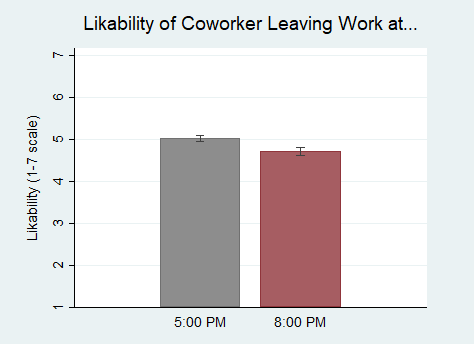
Furthermore, we found no interactions with age, gender, or political beliefs. Even those holding more conservative political views (i.e., Republicans) viewed our late worker with a twinge of contempt.
But it’s not all bad news. The effect seems to be small, only about a quarter of a standard deviation (Cohen’s d = 0.25). It’d be interesting to see if those who work late feel the same way toward others who work late.
Methods Note
We used an independent samples t-test to test for significant differences in perceptions between our two experimental conditions. For significant differences, the difference between the two groups' averages would be large and its corresponding “p-value” would be small. If the p-value is less than 0.05, we consider the difference statistically significant, meaning we'd likely find a similar effect if we ran the study again with this population. To test for significant interactions between the main results and participant demographics, we used OLS regression analyses with interaction terms.
Methods Note
We used an independent samples t-test to test for significant differences in perceptions between our two experimental conditions. For significant differences, the difference between the two groups' averages would be large and its corresponding “p-value” would be small. If the p-value is less than 0.05, we consider the difference statistically significant, meaning we'd likely find a similar effect if we ran the study again with this population. To test for significant interactions between the main results and participant demographics, we used OLS regression analyses with interaction terms.
Popular Experiments

COVID MasksDoes wearing a COVID mask affect how others think of you?
|

Video GamesAre video games more enjoyable than board games?
Does age or gender matter? |

Zero-Sum PoliticsDo Democrats or Republicans view society as win-lose?
|