
Overview
Recent research points to the benefits of a vegetarian diet. For individuals, a vegetarian diet can yield improved health outcomes and lower-cost food options. For society, fewer meat-based meals can reduce CO2 emissions, helping stave off global warming.
But meat is a staple in American culture. In previous experiments we ran here in the U.S., participants were less likely to want to eat food labeled “vegetarian” and rated vegans as less likable, particularly by conservative participants.
We wondered whether such findings would also surface for vegetarians as well, so we tested whether vegetarians are also less liked and whether political beliefs or dietary choices influence these perceptions. We also wondered whether gender plays a role, given the association of meat with more masculine stereotypes.
The Experiment
We conducted an experiment with 400 people on Amazon Mechanical Turk in which participants were told about a hypothetical man or women who either eats a vegetarian diet or a balanced diet. Both gender and diet of the hypothetical person were randomly assigned via 2x2 factorial design, allowing us to look at both effects separately and simultaneously.
Participants were told the following:
Recent research points to the benefits of a vegetarian diet. For individuals, a vegetarian diet can yield improved health outcomes and lower-cost food options. For society, fewer meat-based meals can reduce CO2 emissions, helping stave off global warming.
But meat is a staple in American culture. In previous experiments we ran here in the U.S., participants were less likely to want to eat food labeled “vegetarian” and rated vegans as less likable, particularly by conservative participants.
We wondered whether such findings would also surface for vegetarians as well, so we tested whether vegetarians are also less liked and whether political beliefs or dietary choices influence these perceptions. We also wondered whether gender plays a role, given the association of meat with more masculine stereotypes.
The Experiment
We conducted an experiment with 400 people on Amazon Mechanical Turk in which participants were told about a hypothetical man or women who either eats a vegetarian diet or a balanced diet. Both gender and diet of the hypothetical person were randomly assigned via 2x2 factorial design, allowing us to look at both effects separately and simultaneously.
Participants were told the following:
Below are a few facts about a person you haven’t met yet.
Based only on the information above, how much do you like this person? (1 = Not at all, 7 = Extremely)
- [Male / Female]
- Works at a cafe
- Eats a [balanced / vegetarian] diet
Based only on the information above, how much do you like this person? (1 = Not at all, 7 = Extremely)
Participants then responded to the likability survey question using a 1-7 scale. At the end of the survey, participants were also asked their gender, age, political beliefs, and dietary habits (whether they were a vegan, vegetarian, or neither).
Results
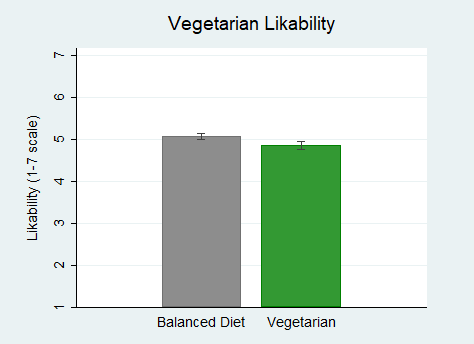
We found a marginal difference in likability (p = 0.073), such that participants liked our vegetarian a bit less (avg. = 4.87) than our balanced diet person (avg. = 5.09). This difference of 0.22 was small though, about a 4.5% difference overall. The results didn’t change much when interacting the diet of our hypothetical person with his/her gender (p = 0.189), nor the gender of our participants (p = 0.173).
Results
We found a marginal difference in likability (p = 0.073), such that participants liked our vegetarian a bit less (avg. = 4.87) than our balanced diet person (avg. = 5.09). This difference of 0.22 was small though, about a 4.5% difference overall. The results didn’t change much when interacting the diet of our hypothetical person with his/her gender (p = 0.189), nor the gender of our participants (p = 0.173).
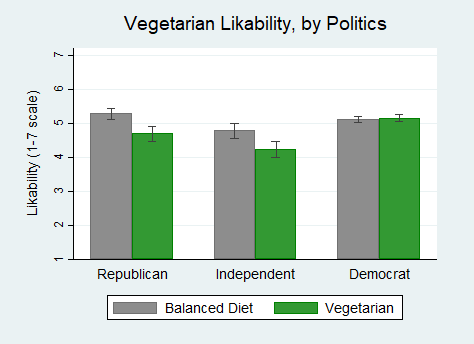
Next, we turn to political beliefs. For Republicans, Independents, and Democrats, the differences in liking our vegetarian versus our balanced diet person were -0.59, -0.55, and +0.05, respectively (1-7 scale). As expected, Republicans were significantly less likely to like our vegetarian than Democrats (p = 0.036). However, we also found that Independents were marginally less likely to like our vegetarian as well (p = 0.069), unlike for the vegan in our previous experiment where there was no difference for Independents.
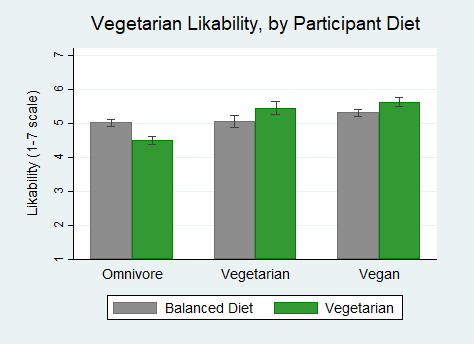
Finally, we tested whether vegetarian likability differed between participants eating regular diets and people eating vegetarian or vegan diets. As expected, we found significant differences between Omnivores (eaters of meat and vegetables) and both vegetarians (p = 0.005) and vegans (p = 0.008). Whereas omnivores liked our vegetarian person 0.53 points less than our balanced diet person, vegetarians and vegans liked the vegetarian person 0.39 and 0.31 more. Our sample of participants included 263 omnivores, 67 vegetarians, and 70 vegans.
Conclusion
Overall, it seems like there’s still a slight social penalty for adhering to a vegetarian diet. However, this penalty is smaller than vegan’s and is muted for liberals and fellow vegetarians and vegans. Thus, although society is still learning to accept the vegetarian diet, we do seem to be making progress.
Overall, it seems like there’s still a slight social penalty for adhering to a vegetarian diet. However, this penalty is smaller than vegan’s and is muted for liberals and fellow vegetarians and vegans. Thus, although society is still learning to accept the vegetarian diet, we do seem to be making progress.
Methods Note:
We used an independent samples t-test to test for significant differences in perceptions between our vegetarian and balanced eater, For significant differences, the coefficient would be large and its corresponding “p-value” would be small. If the p-value is less than 0.05, we consider the difference statistically significant. To test for interactions (a difference in the differences) between the main results and participants' age, gender, political beliefs, or dietary habits, we used OLS regression analyses with interaction terms.
Popular Experiments

COVID MasksDoes wearing a COVID mask affect how others think of you?
|

Video GamesAre video games more enjoyable than board games?
Does age or gender matter? |

Zero-Sum PoliticsDo Democrats or Republicans view society as win-lose?
|